admin
admin 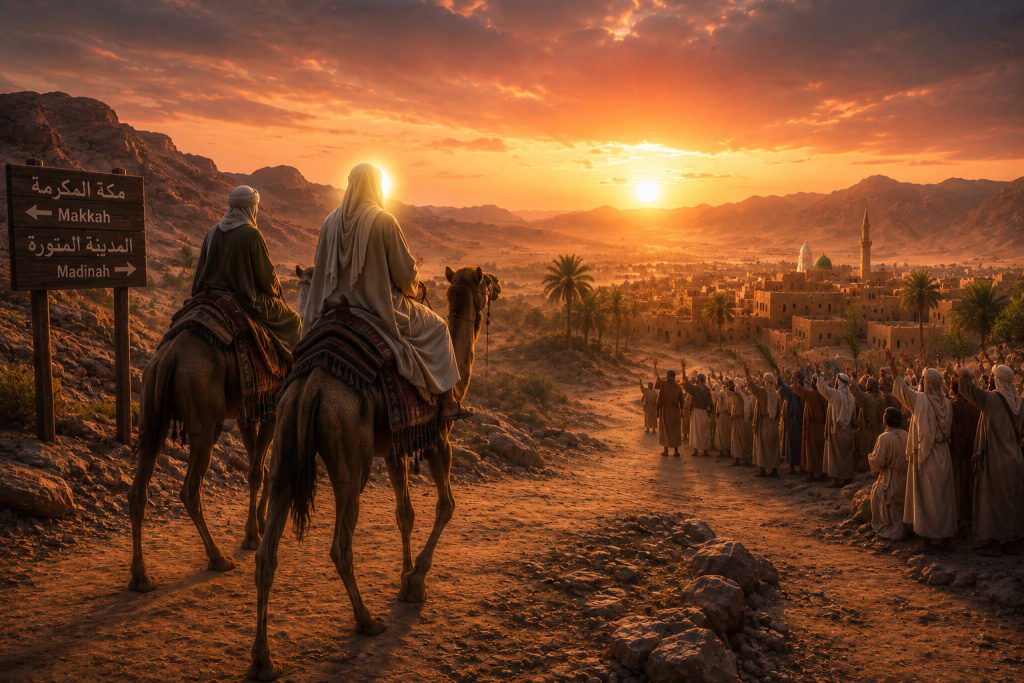
The Hijrah of Prophet Muhammad (Peace and Blessings Be Upon Him): A Turning Point in Islamic History
Introduction
The Hijrah (Migration) of Prophet Muhammad (Peace and Blessings Be Upon Him) from Makkah to Madinah is one of the most significant events in Islamic history. It was not merely a journey from one city to another; it was a remarkable act of faith, patience, sacrifice, and complete trust in Allah. The Hijrah marked the beginning of a new chapter for the Muslim community and laid the foundation for the first Islamic society based on justice, faith, brotherhood, and compassion.
Today, the Islamic calendar begins with the Hijrah because it represents the triumph of faith over persecution and the establishment of a community dedicated to the worship of Allah.
The Situation in Makkah
For thirteen years after receiving prophethood, Prophet Muhammad (Peace and Blessings Be Upon Him) preached the message of Islam in Makkah. He called people to worship Allah alone and abandon idolatry.
The leaders of the Quraysh strongly opposed his message because they feared losing their political influence, social status, and economic power. As a result, the Prophet and his followers faced severe persecution.
Many Muslims were tortured, boycotted, deprived of their property, and forced to endure immense hardship. Despite these trials, the Prophet remained patient and continued to spread the message of Islam with wisdom and kindness.
Permission to Migrate
As the persecution intensified, Allah granted the Prophet permission to migrate to Madinah. Before his own migration, many of the Muslims had already left Makkah and settled there.
The people of Madinah had accepted Islam and pledged to protect the Prophet if he came to their city. Their support created the opportunity to establish a peaceful Muslim community where believers could practice their faith freely.
The Plot to Assassinate the Prophet
When the Quraysh realized that the Prophet planned to leave Makkah, they held a meeting and agreed on a plan to assassinate him.
According to the plan, young men from different tribes would attack him together so that responsibility for the killing would be shared among all the tribes.
However, Allah informed His Messenger of their conspiracy. On the night of the planned attack, the Prophet instructed Ali ibn Abi Talib (may Allah be pleased with him) to sleep in his bed while he quietly left the house with Abu Bakr (may Allah be pleased with him).
This event demonstrated the Prophet’s courage, wisdom, and complete reliance upon Allah.
The Journey to the Cave of Thawr
Instead of taking the direct route to Madinah, the Prophet and Abu Bakr traveled south to the Cave of Thawr, where they remained hidden for three days.
The Quraysh searched intensely for them and even reached the entrance of the cave.
Abu Bakr became concerned that if the pursuers looked down, they would discover them. The Prophet calmly reassured him by saying:
“Do not grieve. Indeed, Allah is with us.”
This statement reflects one of the greatest lessons of the Hijrah: true believers place their complete trust in Allah, even in the most difficult circumstances.
The Journey to Madinah
After the search had subsided, the Prophet and Abu Bakr continued their journey toward Madinah with the help of an experienced guide.
The journey across the desert was long and challenging. They traveled through mountains, rocky valleys, and open desert while avoiding the routes commonly used by travelers.
Throughout the journey, Allah protected His Messenger from every danger.
Arrival in Madinah
When the Prophet arrived near Madinah, the people welcomed him with great joy. Men, women, and children gathered to greet him with love and gratitude.
His arrival marked the beginning of a new era in Islamic history.
One of his first actions was to build Masjid Quba, the first mosque established during the Hijrah. Soon afterward, he reached Madinah, where Al-Masjid an-Nabawi (the Prophet’s Mosque) became the spiritual and social center of the Muslim community.
Building the First Islamic Society
In Madinah, Prophet Muhammad (Peace and Blessings Be Upon Him) established a society based on faith, justice, and mutual respect.
Among his greatest achievements were:
- Establishing brotherhood between the Muhajirun (the emigrants from Makkah) and the Ansar (the helpers of Madinah).
- Building the Prophet’s Mosque as the center of worship, education, and community affairs.
- Promoting justice, equality, and compassion.
- Protecting the rights of all members of society.
- Encouraging cooperation, charity, and peaceful coexistence.
His leadership transformed Madinah into a model community founded on moral values and social responsibility.
Lessons from the Hijrah
The Hijrah teaches timeless lessons that remain relevant today:
- Trust Allah in every situation.
- Be patient during hardship.
- Make sacrifices for truth and righteousness.
- Plan carefully while relying upon Allah.
- Stand firm in faith despite opposition.
- Build communities based on justice, unity, and compassion.
- Remember that every difficulty is followed by ease.
These lessons continue to inspire Muslims around the world.
The Significance of the Hijrah
The Hijrah was far more than a migration. It marked the transition of the Muslim community from persecution to freedom and from weakness to strength.
It also demonstrated that success comes through faith, perseverance, wisdom, and reliance upon Allah.
For this reason, the Hijrah remains one of the greatest milestones in the history of Islam and serves as the starting point of the Islamic (Hijri) calendar.
Conclusion
The Hijrah of Prophet Muhammad (Peace and Blessings Be Upon Him) stands as a powerful symbol of faith, courage, sacrifice, and hope. Despite years of persecution, the Prophet never abandoned his mission. Instead, he trusted Allah completely and continued guiding humanity with patience and mercy.
His migration to Madinah transformed the course of history, leading to the establishment of a peaceful and just Muslim society whose influence spread across the world.
More than fourteen centuries later, the Hijrah continues to remind believers that sincere faith, perseverance, and trust in Allah can overcome even the greatest challenges. It remains one of the most inspiring examples of leadership, devotion, and unwavering commitment to truth in human history.
About the Author