The Prophethood of Prophet Muhammad (Peace and Blessings Be Upon Him): Allah’s Greatest Blessing to Humanity
 admin
admin The Prophethood of Prophet Muhammad (Peace and Blessings Be Upon Him): Allah’s Greatest Blessing to Humanity
Introduction
Prophethood is one of the greatest and most sacred institutions in human history. Throughout the ages, Allah Almighty sent many prophets and messengers to guide humanity toward the truth. Through them, people learned about Allah, the purpose of life, righteous conduct, and the path to eternal salvation. The final and greatest of all these prophets is Prophet Muhammad (Peace and Blessings Be Upon Him). With his mission, the chain of prophethood came to an end, and Islam was perfected as a complete way of life.
Allah Almighty says in the Holy Qur’an:
“Muhammad is not the father of any of your men, but he is the Messenger of Allah and the Seal of the Prophets.”
(Surah Al-Ahzab 33:40)
The prophethood of Prophet Muhammad (Peace and Blessings Be Upon Him) is not merely a historical event. It is a divine mercy, guidance, and a source of salvation for all humanity.
What Is Prophethood?
The word “Prophethood” comes from the Arabic word “Nabi,” which means a prophet chosen by Allah to receive divine revelation and convey His message to mankind.
A Messenger (Rasul) is a prophet who is sent with divine laws or a revealed scripture to guide a particular nation or, in some cases, all of humanity.
Prophet Muhammad (Peace and Blessings Be Upon Him) was both a Prophet and a Messenger. He was sent not only to the Arabs but to all people until the Day of Judgment.
His Life Before Prophethood
Even before receiving prophethood, Prophet Muhammad (Peace and Blessings Be Upon Him) was widely respected in Makkah for his exceptional character. Because of his honesty, integrity, and trustworthiness, the people gave him the titles Al-Amin (The Trustworthy) and As-Sadiq (The Truthful).
He never worshipped idols, never lied, never cheated, and never participated in the immoral practices that were common in Arabian society.
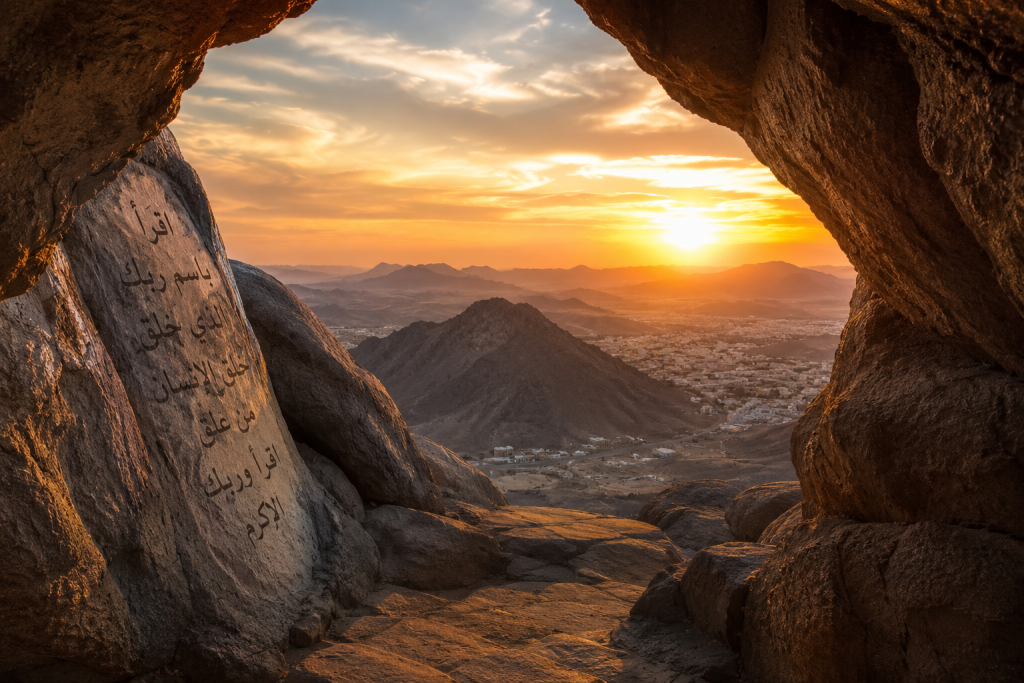
The moral corruption of his people deeply saddened him. Seeking peace and spiritual reflection, he frequently withdrew to the Cave of Hira on Jabal al-Nur (the Mountain of Light) near Makkah, where he spent long periods in worship and contemplation.
The First Revelation
When Prophet Muhammad (Peace and Blessings Be Upon Him) reached the age of forty, during the month of Ramadan, the Angel Jibril (Gabriel) came to him while he was worshipping in the Cave of Hira.
The angel commanded him:
“Read!” (Iqra’)
The Prophet replied:
“I cannot read.”
The angel embraced him firmly and repeated the command. After the third time, Jibril recited the first verses of the Holy Qur’an:
“Read in the name of your Lord who created—created man from a clinging substance. Read, and your Lord is the Most Generous, Who taught by the pen, taught man what he did not know.”
(Surah Al-‘Alaq 96:1–5)
These were the very first verses of the Qur’an ever revealed. This moment marked the beginning of Prophet Muhammad’s mission and the start of a new era in human history.
The Events Following the First Revelation
After receiving the first revelation, Prophet Muhammad (Peace and Blessings Be Upon Him) returned home deeply overwhelmed and said to his wife:
“Cover me! Cover me!”
His beloved wife, Khadijah (may Allah be pleased with her), comforted him and reassured him by saying:
“By Allah, Allah will never disgrace you. You maintain family ties, help those in need, support the poor, honor your guests, and stand for truth and justice.”
She then took him to her cousin Waraqah ibn Nawfal, a learned man familiar with the previous scriptures.
After hearing the Prophet’s account, Waraqah said:
“This is the same angel who came to Moses. You are the Prophet of this nation.”
His words confirmed that Muhammad (Peace and Blessings Be Upon Him) had truly been chosen by Allah as His final Messenger.
The Significance of His Prophethood
The prophethood of Prophet Muhammad (Peace and Blessings Be Upon Him) is one of Allah’s greatest blessings upon humanity. Through him, mankind received guidance in every aspect of life.
His message taught:
- The worship of Allah alone (Tawhid).
- Justice, compassion, and equality.
- The importance of honesty and noble character.
- The rights of women, orphans, and the poor.
- Accountability in the Hereafter.
- The path to earning Allah’s pleasure.
- Islam as a complete and balanced way of life.
Within just twenty-three years of prophethood, he transformed a society once immersed in ignorance, tribal conflict, and idolatry into one founded upon faith, justice, knowledge, and moral excellence. His teachings continue to inspire billions of people across the world today.
Conclusion
The prophethood of Prophet Muhammad (Peace and Blessings Be Upon Him) stands as Allah’s greatest mercy to humanity. The light that began with the first revelation in the Cave of Hira soon spread across Arabia and eventually reached every corner of the world.
His message led people from polytheism to the worship of the One True God, from ignorance to knowledge, and from injustice to justice. His life remains the finest example of faith, integrity, patience, mercy, and leadership.
For every Muslim, believing in his prophethood, loving him, following his Sunnah, and striving to live according to his teachings are essential parts of faith. His timeless message continues to guide humanity toward righteousness, peace, and eternal success.
About the Author