admin
admin Understanding the identity of Allah (God) and His essential attributes is the foundational core of Islamic faith (Iman). It is impossible to fully encompass the divine essence of Allah in limited human language, as the finite human mind cannot fully comprehend the infinite. However, through the Holy Qur’an, the Prophetic traditions (Hadith), and Islamic theology (Aqeedah), Allah has revealed a profound and clear description of Himself.
Here is a comprehensive overview of the identity of Allah in Islam.
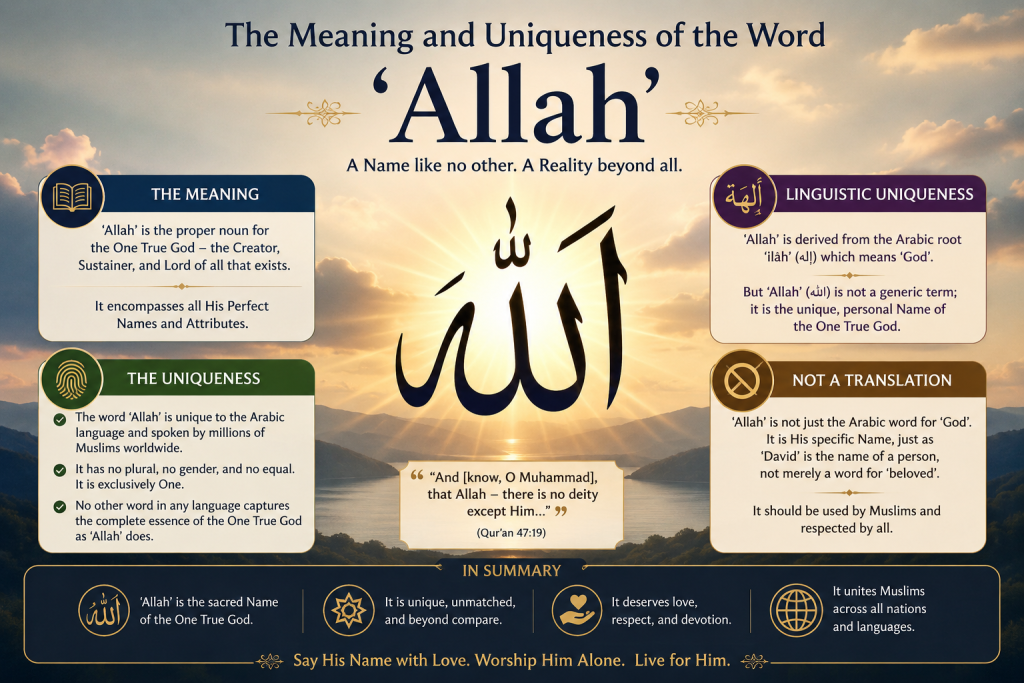
1. The Meaning and Uniqueness of the Word ‘Allah’
The word ‘Allah’ is the supreme and sacred proper name of God in the Arabic language. It is a unique term that holds no plural and no gender.
- Unlike other languages where words for God can be pluralized (e.g., gods) or feminized (e.g., goddess), the word ‘Allah’ cannot be altered.
- It refers exclusively to the One, Unique, and Absolute Supreme Being who is the Creator, Sustainer, and sole Sovereign of the universe.
2. Tawheed: The Oneness of Allah
The core of Allah’s identity is Tawheed (Monotheism). To truly know Allah, one must understand Tawheed, which is traditionally classified into three interconnected dimensions:
A. Tawheed ar-Rububiyyah (Oneness of Lordship)
This is the belief that Allah alone is the Creator, Provider, Giver of Life, Causer of Death, and Ruler of the universe. No other entity shares in His dominion or controls the laws of nature.
B. Tawheed al-Uluhiyyah (Oneness of Worship)
This asserts that Allah is the only one worthy of worship, devotion, prayer, and submission. Directing acts of worship—such as supplication (Dua), bowing, or ultimate obedience—to prophets, saints, angels, or idols is strictly forbidden (Shirk).
C. Tawheed al-Asma was-Sifat (Oneness of Names and Attributes)
This means believing in all the beautiful names and perfect attributes that Allah has ascribed to Himself in the Qur’an and Hadith, without distorting their meanings, denying them, or comparing them to human qualities.
3. Surah Al-Ikhlas: The Definitive Definition
Allah has summarized His own identity in one of the shortest yet most profound chapters of the Qur’an, Surah Al-Ikhlas (Chapter 112):
“Say, ‘He is Allah, [who is] One. Allah, the Absolute Sovereign (the Eternal Refuged). He neither begets nor is He born. And there is none co-equal or comparable unto Him.'” (Qur’an, 112:1-4)
This Surah completely dismantles any concept of polytheism, anthropomorphism, or the idea that God has a family. He is As-Samad (the self-sufficient, whom all creation needs, but who needs nothing).
4. Ayat al-Kursi: The Verse of Divine Majesty
The most prestigious verse in the Qur’an is the “Verse of the Throne” (Surah Al-Baqarah, 2:255). It outlines Allah’s grandeur and absolute authority:
- The Living and Eternal: He is Al-Hayy (The Ever-Living) and Al-Qayyum (The Sustainer of all existence).
- Flawless Power: Neither drowsiness nor sleep can overtake Him.
- Absolute Ownership: To Him belongs whatever is in the heavens and the earth.
- Infinite Knowledge: He encompasses all of the past, present, and future. Human knowledge is limited only to what He chooses to reveal.
- Effortless Protection: Guarding and maintaining the entire universe does not tire Him in the slightest, for He is the Most High, the Most Great.
5. Al-Asma-ul-Husna (The Most Beautiful Names)
The best way to understand Allah’s character and relationship with His creation is through His 99 Beautiful Names. Some of the primary names include:
| Name (Arabic) | Translation | Concept & Meaning |
| Ar-Rahman (الرحمن) | The Most Gracious | His mercy is vast and encompasses all creation (believers and non-believers alike) in this world. |
| Ar-Rahim (الرحيم) | The Most Merciful | His specific, comforting mercy reserved especially for the believers, particularly in the afterlife. |
| Al-Malik (الملك) | The Absolute Sovereign | The true King and ultimate Owner of all reality. |
| Al-Quddus (القدوس) | The Pure / Holy | The One who is absolutely free from any flaw, weakness, or human imperfection. |
| Al-Khaliq (الخالق) | The Creator | The One who brings everything from nothingness into existence. |
| Al-Ghafur (الغفور) | The All-Forgiving | The One who repeatedly pardons sins, no matter how immense, when a servant turns to Him in repentance. |
6. Recognizing Allah Through Creation
In Islamic theology, the entire universe serves as a living mirror reflecting the existence and attributes of Allah.
- The perfect calibration of galaxies, the cycle of day and night, and the precise laws of physics point to a Supreme Intelligence and Designer.
- The complex biological systems within human beings—from the beating of the heart to the blueprint of DNA—are signs (Ayat) of His masterful craftsmanship.
- The Qur’an consistently urges humanity to observe nature—the rain reviving dead soil, the flight of birds, the diversity of languages and colors—as direct proofs of Allah’s power and benevolence.
Conclusion
Ultimately, Allah is the First (Al-Awwal) without a beginning, and the Last (Al-Akhir) without an end. He is the Source of all light, life, and justice. He is intimately close to His creation, hearing the silent prayer of a desperate heart, while simultaneously managing the vast, infinite cosmos.
In Islam, knowing Allah is not just an intellectual exercise; it is an emotional and spiritual journey. True recognition of Allah inspires profound love, healthy awe, and an inner peace that guides a person to live a life of righteousness and purpose.
About the Author